How does a CRA payroll remittance work? Learn your 2 options in ABMBooks: remit source deductions yourself, or let ABMBooks remit for you every time you run payroll.
A CRA payroll remittance is the payment you send to the Canada Revenue Agency for the income tax, CPP, and EI you deduct from your employees’ pay, plus your employer share of CPP and EI. It’s one of the most important parts of running payroll in Canada — and one of the easiest to fall behind on. According to Dawit Teferi, CEO of ABMBooks and a CPA and CMA, ABMBooks gives you two simple options for handling it.
How Do CRA Payroll Remittances Work?
Every time you pay employees, you withhold income tax, CPP contributions, and EI premiums. You then send those amounts, plus your employer share of CPP and EI, to the CRA by your remittance due date. In ABMBooks, you can either remit the amount the software calculates yourself, or let ABMBooks remit for you through its direct deposit service.
- Withhold: income tax, CPP, and EI from each paycheque
- Add: your employer share of CPP and EI
- Remit: send the total to the CRA by your due date, usually the 15th of the following month for regular remitters
Table of Contents
What Are Your 2 Options for Remitting Payroll Deductions in ABMBooks?
ABMBooks gives you two ways to handle your CRA payroll remittance. You can remit source deductions yourself, using the exact amount ABMBooks calculates, or opt into the ABMBooks direct deposit service and have ABMBooks deduct and remit them for you every time you run payroll, with no extra steps on your end.
| Option 1: Remit it yourself | Option 2: ABMBooks remits for you | |
|---|---|---|
| Who calculates the amount | ABMBooks | ABMBooks |
| Who sends the payment to the CRA | You | ABMBooks |
| When it happens | CRA due date, regular or accelerated | CRA due date, regular or accelerated |
| What you need | Any ABMBooks payroll plan | The ABMBooks direct deposit service |
| Best for | Owners who want to control every payment | Owners who want remittances fully hands-off |
How Do You Remit Payroll Deductions Yourself?
If you choose to remit yourself, ABMBooks does the math and you make the payment to the CRA. As Dawit explains, without a direct deposit, the software calculates how much remittance you need to pay, and then you simply go ahead and remit the funds to the government. Here’s the step-by-step process:
How to remit CRA payroll deductions yourself using the amount ABMBooks calculates.
Run payroll in ABMBooks
Process your pay run as usual. ABMBooks calculates income tax, CPP, and EI for each employee, along with your employer share of CPP and EI.
Review the remittance amount
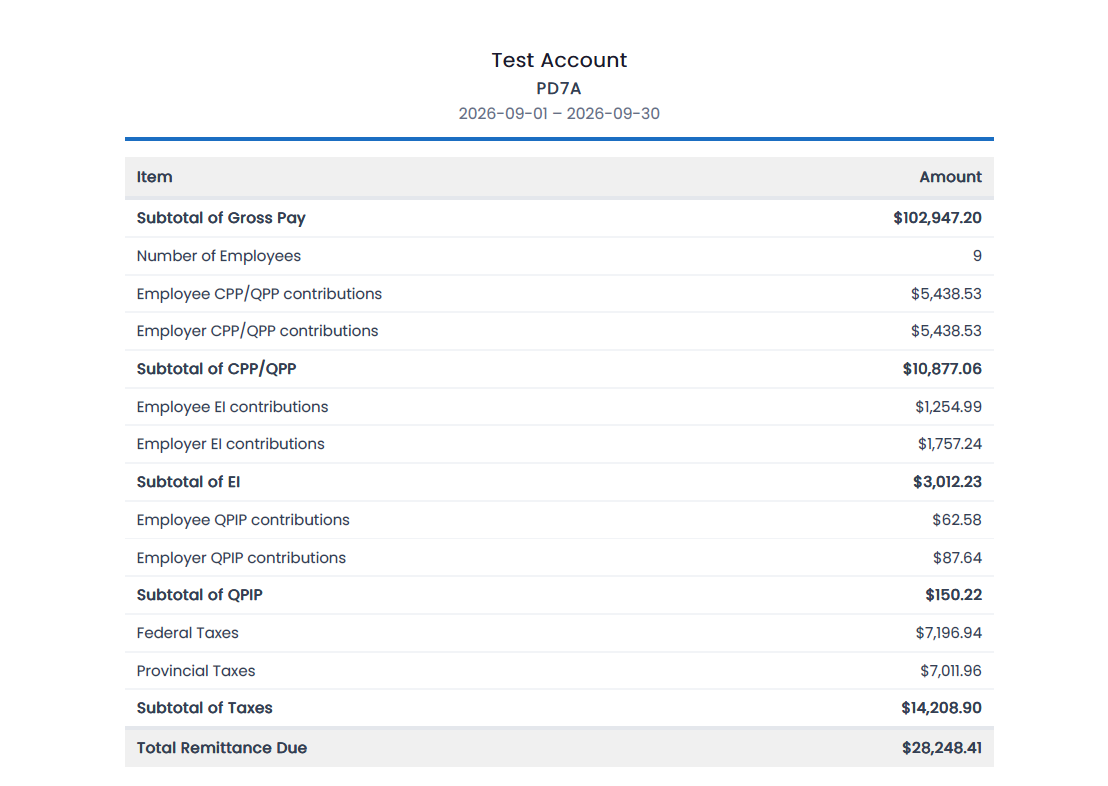
ABMBooks shows exactly how much you owe the CRA for the period, using its PD7A remittance reporting, so there is nothing to calculate by hand.
Remit the funds to the CRA
Send the payment to the CRA through your bank or the CRA’s payment options so it is received by your due date, usually the 15th of the following month for regular remitters.
Keep your records
Keep your payroll and remittance records for at least six years. ABMBooks stores your pay runs and remittance reports together, so they are easy to find.
When Are CRA Payroll Remittances Due?
Your due date depends on your remitter type, which the CRA assigns based on your average monthly withholding amount (AMWA). Most small businesses and new employers are regular remitters, which means the CRA has to receive your deductions by the 15th day of the month after the month you paid your employees. Here’s how the main remitter types compare:
| Remitter type | Average monthly withholding (AMWA) | When the CRA must receive your remittance |
|---|---|---|
| Quarterly | Less than $1,000 (new employers) or $3,000 (eligible employers) | By the 15th day of the month after each quarter ends |
| Regular (most small businesses) | Less than $25,000 | By the 15th day of the month after you paid employees |
| Accelerated, threshold 1 | $25,000 to $99,999.99 | Up to twice a month |
| Accelerated, threshold 2 | $100,000 or more | Up to four times a month |
For full details, see the CRA’s When to remit (pay) page and the Employers’ Guide – Payroll Deductions and Remittances.
What Does the ABMBooks Direct Deposit Service Handle?
If you’d rather not remit source deductions yourself, the ABMBooks direct deposit service handles it for you. ABMBooks deducts the remittances every time your payroll runs and remits them to the government without any hassle on your end. There are two service levels on the ABMBooks pricing page:
- Basic direct deposit ($8 for the first employee + $2 per additional employee): you run payroll in ABMBooks; ABMBooks deposits your employees’ pay and remits source deductions to the CRA
- Premium direct deposit ($15 for the first employee + $2 per additional employee): you send a payroll request; the ABMBooks team runs payroll, generates pay stubs, deposits pay, and remits source deductions
To learn more about how direct deposit works for paying your team, see Can ABMBooks Pay My Employees by Direct Deposit?
Which CRA Payroll Remittance Option Is Right for You?
Choose the option that matches how involved you want to be. Remitting yourself keeps every payment in your hands at no extra cost, while the direct deposit service makes your CRA payroll remittance automatic so it’s never forgotten. Consider:
- Your time: remitting yourself is quick with ABMBooks’ calculation, but it’s still a task to remember each period
- Your risk tolerance: late remittances can lead to CRA penalties and interest, so automation reduces that risk
- Your cash flow: remitting yourself lets you time the payment within the due date
- Your team size: as payroll grows, a hands-off process saves more time
Frequently Asked Questions
What is a CRA payroll remittance?
A CRA payroll remittance is the payment an employer sends to the Canada Revenue Agency for the income tax, CPP contributions, and EI premiums withheld from employees’ pay, plus the employer’s share of CPP and EI. Remittances must be received by your due date, which depends on your remitter type.
When is my CRA payroll remittance due?
It depends on your remitter type. Most small businesses and new employers are regular remitters, so the CRA must receive their deductions by the 15th day of the month after the month they paid employees. Quarterly and accelerated remitters follow different schedules set by the CRA.
Does ABMBooks remit source deductions to the CRA for me?
Yes, if you opt into the ABMBooks direct deposit service. ABMBooks then deducts and remits your source deductions every time you run payroll. Without the service, ABMBooks still calculates exactly how much you owe, and you send the payment to the CRA yourself by your due date.
How much does it cost to have ABMBooks remit for me?
Remitting is included with the ABMBooks direct deposit service. Basic direct deposit is $8 for the first employee and Premium is $15 for the first employee, each plus $2 per additional employee. Check the ABMBooks pricing page for current rates before choosing a service level.
What happens if I remit payroll deductions late?
The CRA can charge penalties and interest on remittances that are late or short. Using software that calculates the exact amount, and remitting by your due date or letting a service remit automatically each pay run, is the simplest way to avoid falling behind on your payroll remittances.
Can I switch between remitting myself and having ABMBooks remit?
ABMBooks is designed to give you options, so you can start by remitting yourself and opt into the direct deposit service later as your business grows. Contact ABMBooks to confirm how and when a change takes effect for your account and payroll schedule.
In Dawit’s Words
“How do CRA remittance payments work? We have two options for you — we will simplify things using a software. Without a direct deposit, the software will calculate for you how much remittance you need to pay, and then you simply go ahead and remit the funds to the government. Or if you want to use our services, you opt into our direct deposit service and we deduct the remittances for you every time your payroll runs, and we remit that to the government without a hassle to yourself. Our goal is always to give you options, and that’s why ABMBooks focuses on giving people options and a simple process.”
— Dawit Teferi, CEO, CPA, CMA, ABMBooks
About the expert: Dawit Teferi is the CEO of ABMBooks, a CPA and CMA, and leads a Canadian tax and accounting practice. He built ABMBooks to solve the payroll and bookkeeping problems he saw small business clients face every day. Learn more about ABMBooks.
Whether you remit it yourself or let ABMBooks handle it, your CRA payroll remittance should be simple, accurate, and on time.