Which financial reports should small business owners look at? A CMA explains the three that matter most — income statement, cash flow, and costing — and why profit on paper isn’t the same as cash in the bank.
Which financial reports for small business owners actually matter? Ask most owners which ones they look at, and you’ll usually get one answer: “I check my bank balance.” That’s understandable — nobody started a business to read financial statements. But the right reports aren’t complicated, and according to Dawit Teferi, our CMA (Certified Management Accountant) at ABMBooks, there are really only three you need to understand.
What Financial Reports Should a Small Business Owner Look At?
Small business owners should focus on three financial reports: the income statement, which shows whether you’re profitable; the cash flow statement, which shows whether that profit has actually turned into money in the bank; and costing, which shows what each product, service, or job really costs you. Together, they give you a clear picture of profit, cash, and margin.
- Income statement (profit and loss): revenue minus expenses over a period
- Cash flow statement: the cash that actually came in and went out over a period
- Costing: the fixed and variable costs behind each sale
Why the Income Statement Alone Can Mislead You
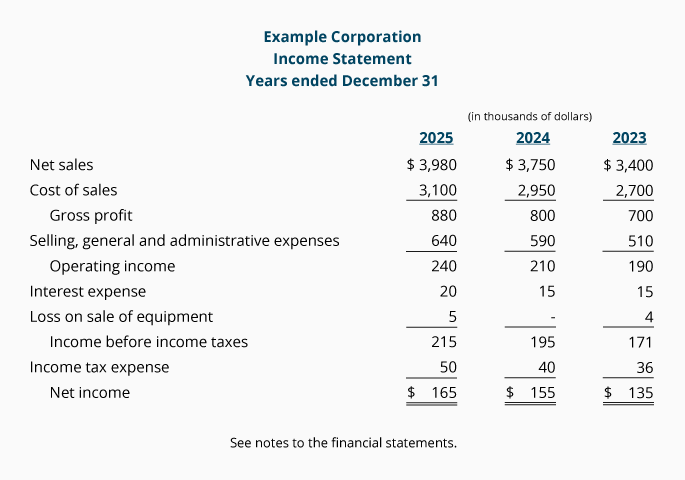
The income statement (also called a profit and loss statement) is where most owners start, and it matters. It tells you whether you earned more than you spent over a period. If you want a refresher, we walk through it in Understanding Profit and Loss Statements with ABMBooks.
The problem is that an income statement counts revenue when you invoice it, not when the money lands. As our CMA puts it, an income statement “can lie to you.” You can have a stack of invoices that have been issued but not collected — so on paper you’re profitable, while in reality your cash is short.
That’s also why the balance sheet tends to get skipped. It’s a more technical report, and a lot of owners don’t find it intuitive. Cash flow, on the other hand, is simple for the most part.
Cash Flow: The Report That Doesn’t Lie
Here’s the example from the video. Say you billed $100,000 over six months, but only collected $50,000. Your income statement shows $100,000 in revenue. Your bank account shows $50,000. The difference is accounts receivable — money customers owe you that you haven’t collected yet.
If you only look at the income statement, you’ll think you’re in better shape than you are. If you only look at the bank balance, you won’t understand why it’s lower than expected. Looking at both together tells you:
- Whether you’re actually profitable — from the income statement
- Whether that profit has turned into cash — from your cash flow
- How much is still sitting in receivables — the gap between the two, and the first place to look when cash feels tight
This isn’t just our view. The Business Development Bank of Canada’s guidance on managing cash flow makes the same point: profit and cash flow are not the same thing, and a business can be profitable while running short on cash.
Costing: Knowing What Each Sale Actually Costs You
The third report is the one most owners never build: costing. Cost accounting is a whole specialty within the CMA designation, and it has a reputation for being a boring topic. But the idea behind it is simple — you need a reliable way to cost what you do.
Start by splitting your costs into two groups:
- Fixed costs — costs that don’t move much with each sale, or that you buy in bulk and spread across many sales
- Variable costs — costs that go up because you sold one more item
The video uses a restaurant example. If you sell a steak, the meat is a variable cost — every extra steak you sell means more meat you have to buy. The butter, on the other hand, is bought in bulk, so you don’t track it per plate; you just assign a cost per serving.
Good costing also accounts for reality. If you plan to sell ten steaks, you might buy a little extra, because something will go wrong — a dropped plate, an overcooked cut, a sent-back order. Building that buffer into your cost is what makes your margins real instead of theoretical.
Costing Is a Philosophy, Not Just a Tool
There are plenty of third-party tools that can help with parts of this — especially in industries like restaurants. ABMBooks can help you too, with built-in financial reports that put your income statement and cash position side by side.
But tools only do their part. As a business owner, you still have to decide how you run your business and how you cost things. That’s what makes costing “philosophical in a way” — it’s a habit of thinking about what each sale really costs you, not a report you print once a year.
The Three Financial Reports, in Summary
- Income statement: are you profitable on paper?
- Cash flow: has that profit actually reached your bank account, and how much is stuck in receivables?
- Costing: do you know what each product, service, or job really costs you — fixed and variable?
Frequently Asked Questions
What is the difference between profit and cash flow?
Profit is what’s left after you subtract expenses from revenue, and it counts sales when you invoice them. Cash flow is the money that actually moves in and out of your bank account. A business can show a profit while running short on cash if customers haven’t paid their invoices yet.
Why doesn’t my bank balance match my income statement?
Usually because of accounts receivable — invoices you’ve issued but haven’t collected. If you billed $100,000 but collected $50,000, your income statement shows $100,000 in revenue while your bank only shows the $50,000 you received. Timing of bills you’ve paid or owe can also create a gap.
Do small businesses need a balance sheet?
Yes — a balance sheet is part of a complete set of financial statements, and incorporated businesses in Canada report balance sheet information with their corporate tax return. But for day-to-day decisions, most owners get more practical value from watching their income statement, cash flow, and costing.
What is the difference between fixed and variable costs?
Fixed costs stay roughly the same no matter how much you sell, or are bought in bulk and spread across many sales. Variable costs rise with each additional sale. In a restaurant, the steak on each plate is a variable cost, while bulk-purchased butter can be assigned as a set cost per serving.
How often should a small business review its financial reports?
At least monthly. Reconciling your bank account and reviewing your income statement and cash flow each month lets you catch collection problems, rising costs, or shrinking margins while there’s still time to act — not at year-end.
In Dawit’s Words
“Cash flow is very important. An income statement can lie to you — you can have a bunch of invoices that have been issued but not collected. So on paper, you’re profitable, but in cash flow, you’re off. … As a business owner, you have to create that philosophy in how you run your business and how you cost things. So I would say, essentially: income statement, cash flow, and costing of everything.”
— Dawit Teferi, CMA, ABMBooks
Financial reports for small business owners don’t need to be overwhelming. Watch three numbers — profit, cash, and cost — and you’ll know more about your business than most of your competitors do. Book a Demo URL